

- The Site is maintained and operated by a third-party vendor, Citrix Systems, Inc. (the “Vendor”), a company that is not affiliated with Ingalls & Snyder, LLC (“Ingalls”). While Ingalls has selected the Vendor based on its belief that the Vendor has commercially reasonable safeguards designed to (i) ensure the security and confidentiality of any non-public information (“Information”) transmitted using the Site, (ii) protect against any anticipated threats or hazards to the security or integrity of Information transmitted using the Site and (iii) protect against unauthorized access to, or use of, Information transmitted using the Site, Ingalls does not exercise any control over the Vendor’s systems and cannot guarantee the privacy and security of any information you choose to transmit using the Site.
- Access to the Site is granted by Ingalls so that you may utilize the Service for your convenience at your sole discretion. Ingalls has no liability for any loss, claim, or other damage that results from unauthorized access to any Information transmitted using the Site. User is solely responsible for the security of Information stored locally on the User’s computer or device as well as any email account User may use to receive and send links to the Site to transmit or receive documents.
Funding the AI Boom

The AI and data center buildout is on track to reach $1 trillion in 2026 alone. Initially funded from the ample free cash flows of tech giants, AI data-center capital spending today is largely financed through debt markets. Since the start of 2025, Alphabet, Amazon and Meta Platforms respectively issued $114 billion, $108 billion and $53 billion of fresh debt. A further $50 billion in debt was issued by Oracle.
The largest tech companies are among the highest rated borrowers and, in theory, their bonds should benefit from very low risk premiums versus US Treasuries. Since issuance, however, the risk spread above Treasuries of new bond issues tied to data center spending has widened, such that “AA” and “AA+” rated issuers now trade in line with the “BBB”-rated index.
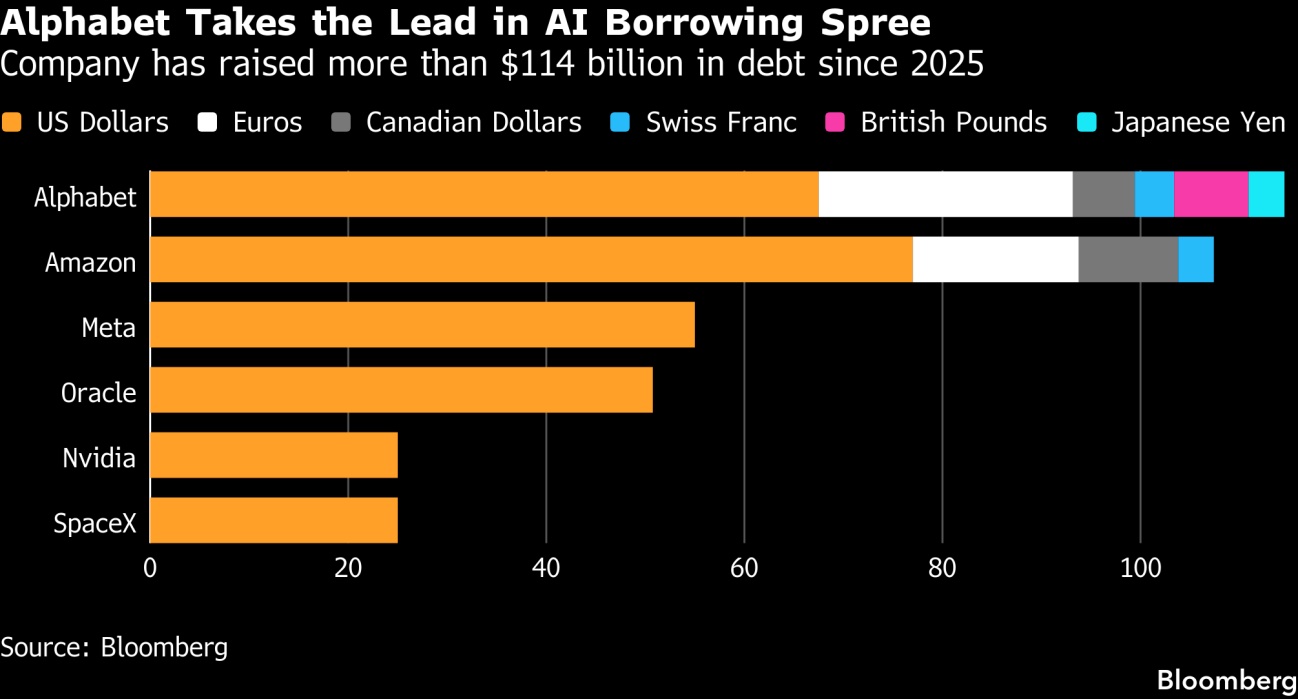
For some, higher debt yields and risk premia are warning lights regarding a potential bust and which will leave us with “bridges to nowhere” and weakened borrowers. For others, the extraordinary phase of capital spending will reinforce competitive advantages in the AI age while generating growing cash flow for shareholders. We are broadly in the latter camp, though we believe it is important to acknowledge the pressures that give rise to skepticism regarding an increasingly debt-fueled AI buildout. Where one stands on this question affects one’s view of tech company stocks as well as bonds.
In our view, the lower prices and wider risk spreads are caused by three factors:
- Uncertainty over the ultimate return on massive investments
- The large size of these issues hitting the market in a relatively short time-frame
- Bond market losses, as Treasury yields are substantially higher since February (the 10-year bond yield is up 0.75% since 2/27 and hit 20-year highs this summer).
Virtually all of the new bond issues funding AI data centers trade at losses. Tech companies, to be sure, are not the only issuers affected by bond-market strains. These reflect near-term inflation driven by hostilities in the Middle East as well as data center spending itself. Bond markets are also unsettled by the recent transition to a new Fed Chief, Kevin Warsh. History shows that new central bank leaders, especially those with novel approaches to both policy and market communication, are typically challenged early in their tenures.
Fundamentals As of June 30th, the combined order backlog of the largest data center operators surpassed $1.5 trillion. While impressive, the such massive and fast-growing order backlogs raise questions. Will customers make good on their future commitments? To what extent do these involve “creative financing” that concentrates funding risks? A widely cited article from Nikkei Asia, “Five US Tech Giant’s Hidden Debts Soar to $1.65tn on Opaque AI Funding,” associates the AI data center buildout with the late 2000s US home financing boom-and- bust. Concerns center on concentrated exposure to future payments from Anthropic and OpenAI, the two largest US-based providers of large language models (LLMs). The major LLM providers are themselves in full spending mode and remain unprofitable. Both hyper-scale data center owners and LLMs are increasingly intertwined through vendor financing arrangements, notably for chips, as well as direct equity ownership.
We disagree with the hyperbole of such articles, though we remain alert to funding risks especially in such a fast-growing industry (indeed, we wrote on this topic in October 2025). In any industry, such as construction or aerospace, with long lead times for production, order backlogs reflect future revenue opportunity while embedding a degree of risk. Contrary to claims of deteriorating credit, the most recent metrics and commentary from Amazon and Microsoft indicate that backlogs are shortening in duration and are less concentrated than they were even 6 months ago. Meanwhile, the estimated viable lifetime of data center investment has increased. These metrics suggest that more revenue will be recorded in the near-term, as chip purchases are allocated to customers; also, that newly built data center properties will not need to be replaced for two decades.
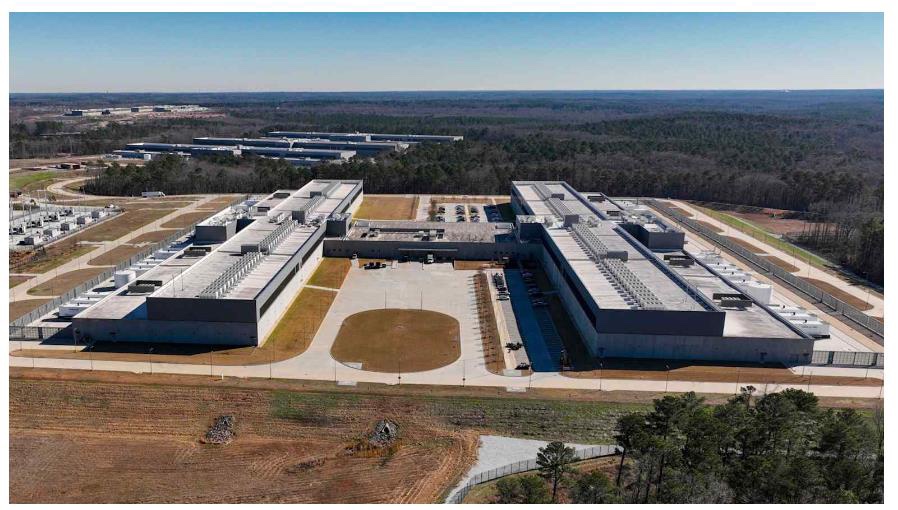
Even after the recent wave of borrowing, current leverage ratios among the biggest tech borrowers are very low, if not negative in certain cases (ie, cash exceeds balance sheet debt). Alphabet (Google) has raised as much new equity as debt in 2026, a fact which provides significant additional support to its competitive ambitions. It is worth noting that Berkshire Hathaway emerged as the lead investor on Alphabet’s $87 billion new equity raise. Berkshire is known for its selectivity and due diligence in underwriting equity and debt purchases, as well as reinsurance policies. As one of the largest power and transportation infrastructure companies in the US, Berkshire also grasps the potential long-term benefits of capital spending that builds stronger “moats.”
Recent results from Microsoft, Amazon and Alphabet revealed the negative impact on cash flow of current high spending. They also demonstrated strong sales and profit growth, before capital expenditures. Alongside clearer metrics regarding backlogs, buoyant growth among the infrastructure players has been broadly well received by the equity markets, which have enabled significantly higher stock valuations. We note, however, that debt markets have not reacted as positively, for the reasons cited above.
Perspectives The shifting business models of the largest US tech companies reflect a fundamental shift in innovation and the competitive landscape. Despite heightened concern over AI-related capital spending, we do not see the type of balance sheet deterioration that would be indicative of a credit problem.
4 factors inform our relatively favorable view of the currently discounted tech debt issues:
❖ dominant business models carving new advantages in the AI age
❖ proven management teams – demonstrating the ability to identify areas of strong growth
❖ fundamental financial strength, with low net leverage & strong cash generation
❖ high equity valuations, $2-4 trillion - which offer a high margin of safety and financial flexibility
The above considerations support owning these debt issues at current discount prices. For that matter, they help support the investment case for owning their equities.
We are grateful for the confidence you have placed in our abilities. We welcome your observations and questions, as always. Sincerely, Bridgehampton Group For questions or follow-up, please reach out to any member of our team. https://www.ingalls.net/bridgehamptongroup/about-us
Ingalls Investment Management, LLC, is an investment advisor registered with the U.S. Securities & Exchange Commission. This material is being provided to you for informational purposes only and is not intended to be a general guide to investing, or as a source of any specific investment recommendation and makes no implied or express recommendation concerning the manner in which any account should be handled. Any investment program involves certain risks, including loss of principal, and no assurance can be given that any specific investment objective will be achieved. More information about Ingalls Investment Management may be found at: https://www.ingalls.net/important-information.

Ingalls & Snyder is a brand name used for the affiliated companies of I&S Group, LLC. Bridgehampton Group is a team at Ingalls & Snyder that offers investment advisory and brokerage services. Investment advisory services are offered through Ingalls Investment Management, LLC ("IIM"), an SEC registered investment adviser, and brokerage services are offered through Ingalls & Snyder, LLC ("INGS"), a member of FINRA and SIPC. When offering investment advisory services, individuals act as investment advisor representatives or, otherwise, employees of IIM. When offering brokerage services, individuals act as a registered representatives or associated persons of INGS.
For more information and disclosures regarding Ingalls & Snyder, LLC and Ingalls Investment Management, LLC, please visit the Important Information page. In addition, you may check Ingalls’ regulatory history and background on FINRA’s BrokerCheck website.