

- The Site is maintained and operated by a third-party vendor, Citrix Systems, Inc. (the “Vendor”), a company that is not affiliated with Ingalls & Snyder, LLC (“Ingalls”). While Ingalls has selected the Vendor based on its belief that the Vendor has commercially reasonable safeguards designed to (i) ensure the security and confidentiality of any non-public information (“Information”) transmitted using the Site, (ii) protect against any anticipated threats or hazards to the security or integrity of Information transmitted using the Site and (iii) protect against unauthorized access to, or use of, Information transmitted using the Site, Ingalls does not exercise any control over the Vendor’s systems and cannot guarantee the privacy and security of any information you choose to transmit using the Site.
- Access to the Site is granted by Ingalls so that you may utilize the Service for your convenience at your sole discretion. Ingalls has no liability for any loss, claim, or other damage that results from unauthorized access to any Information transmitted using the Site. User is solely responsible for the security of Information stored locally on the User’s computer or device as well as any email account User may use to receive and send links to the Site to transmit or receive documents.
Impressions from the Berkshire Hathaway Annual Meeting

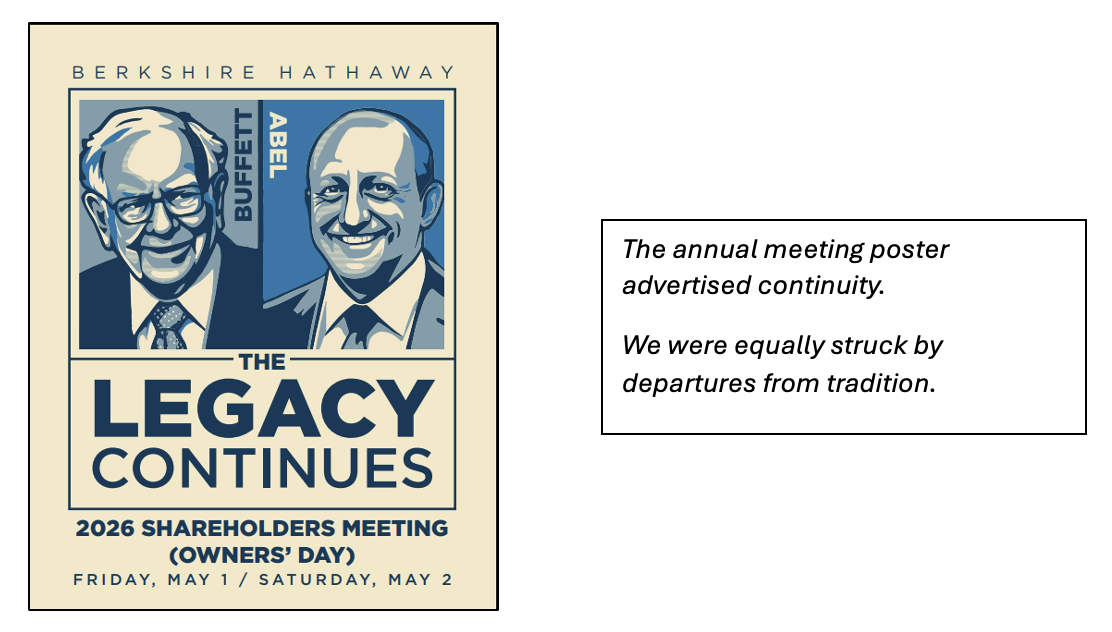
Members of the Bridgehampton Group attended the 2026 Berkshire Hathaway Annual Meeting in Omaha. This year was the occasion for Berkshire’s new CEO, Greg Abel, to present his view of Berkshire, past, present and future. Given the leadership transition and general interest in Berkshire, we provide our impressions on the meeting below.
Deepfake Warren: What is the investment case for Berkshire Hathaway?
Leading the annual meeting Q&A, a “deepfake” Warren Buffet asks newly-appointed CEO Greg Abel whether Buffett should hold on to his Berkshire shares. He’s “known the company for a long time,” after all, and he keeps “a not insignificant part of my wealth” in Berkshire. The AI-generated Buffet is designed to be humorous – and to suggest that Berkshire itself is already in the AI world, one where Buffett will be an immortal presence.
In true Buffett fashion, the question is both funny and profound: what is the investment case for Berkshire today?
Abel needed six minutes to reply. At any credible pitch contest – including the one we attended Saturday night at Johnny’s Café in downtown Omaha – he would have been drummed out of the room.
One learns to be patient with Berkshire. During the first two minutes of his response, Abel enumerated the conglomerate’s various divisions and assets, which we already knew. When his inventory check at last came to Berkshire’s $385 billion cash balance, Abel broke his narrative to emphasize that we aren’t going to be beholden to anyone. At that juncture, the pitch began to warm. In the end, a patient listener could discern the contours of an investment case.
In more succinct fashion, Abel could have said:
Berkshire is uniquely positioned to scale high-return industrial and financial businesses while limiting downside and capitalizing on dislocations due to changes in market and business environments.
Tim Cook
The symbolism of succession and the new operational thrust of Abel’s mandate as Berkshire’s new CEO was reinforced by the appearance at the annual meeting of Apple CEO, Tim Cook. Apple is Berkshire’s largest equity holding, currently worth $185 billion. As Buffett reminded us, Cook succeeded the visionary Steve Jobs and engineered a highly successful period for Apple’s shareholders (and Berkshire’s). We wonder whether Cook, who recently announced his own CEO succession at Apple, will soon be a candidate for Berkshire’s board. He would bring tech industry leadership while reinforcing Berkshire’s operational focus.
The art of doing nothing
“It is hard to find people who are willing to sit back and do nothing…especially while everyone else is out doing deals, wining and dining, etc.” Ajit Jain, the architect and leader of Berkshire’s insurance business, which generates nearly 40% of group profit, provided a philosophical complement to Abel during the annual meeting. He reminded many, including Abel, of the late Charlie Munger. As Jain suggested, Berkshire will remain a patient organization – one which acts opportunistically, and which is also keenly aware of the risks intrinsic to its own businesses. The message is clear: there will always be “excess” cash on Berkshire’s balance sheet.
Jain reviewed the recent multi-faceted transaction with Tokio Marine, one of Japan’s largest insurers, as an example of a transaction that fits within Berkshire’s risk appetite and commercial strategy. The $1.8 billion investment in Tokio (equivalent to a 2.5% stake) announced in February, combines with a commercial agreement for Berkshire’s re-insurance business to support Tokio’s underwriting growth.
How will Berkshire grow?
Energy
CEO Abel addressed the growth potential inherent to Berkshire’s position as one of the largest providers of power to data centers in North America. While profitable, Berkshire’s utility business is subject to the “regulatory compact” governing its return on equity. The opportunity to earn additional revenue needs to be measured against the risk of operating regulated assets, particularly in areas prone to wildfires.
Railroads
One the major North American railroads, BNSF also shows potential to improve operating metrics. BNSF owns and operates an extensive rail network anchored in the western US. The railroad hasn’t applied “precision railroading” to the same extent as peers; though BNSF is nicely profitable (operating margins are over 30%), its efficiency ratios trend toward the bottom of the league.
Insurance
Berkshire’s insurance businesses are broadly retrenching, though it is important to distinguish the reasons for the retrenchment among different insurance lines. GEICO repriced its policies in recent years and subsequently ceded major market share to Progressive, its primary competitor.
Berkshire’s re-insurance and P&C insurance businesses have withdrawn underwriting capacity as outside capital chases higher returns. From 2022-2024, reinsurance premiums spiked due to the increased frequency and severity of climate events. Reinsurance is also the one most subject to near-term changes in underwriting capacity. After last year’s California wildfires, catastrophe losses have been benign and prices have dropped as new capital pools entered the market.
Portfolio Management
The value of Berkshire’s stock portfolio will be in capable hands, though its premium will diminish through the phased retirement of the legendary Buffett. Still, Berkshire has an extraordinary balance sheet capacity which enables it to invest a large proportion of excess cash in equities.
Thinking about Berkshire under new leadership
While investors offer many suggestions as to how Berkshire’s ROE could be improved by investing more cash, we should be equally mindful of how Berkshire manages its own business risks.
In his brief remarks at this year’s meeting, Buffett stated that “around here, we like to get others to do the work for us.” The phrase sounded witty in Buffett’s folksy, laconic way, but it didn’t reassure us. In contrast to Warren and Charlie, Abel made his career operating businesses. He is not a storyteller or a showman; nor is he a star stock-picker. He will be a very hands-on, operationally-focused CEO – and he will likely generate tension along the way.
We welcome the change in Omaha.
The material is not to be reproduced or distributed to others without Ingalls & Snyder, LLC’s (“Ingalls” or the “Firm”) express written consent. This material is being provided for informational purposes and any opinions expressed in this material are only opinions at the time of writing. Nothing provided by Ingalls should be considered tax or legal advice, and clients should seek advice from their tax and legal professionals. Bridgehampton is a team at Ingalls & Snyder, LLC, an investment advisor registered with the Securities & Exchange Commission and a FINRA member broker dealer. More information including the firm’s Form ADV Brochure and Form CRS can be found at https://www.ingalls.net/importantinformation
The content provided herein is for informational purposes only. The statements are believed to be accurate at the time of writing, but tax laws may change. The statements provided do not contemplate each individuals unique financial circumstances. Therefore, you should consult a professional legal and tax advisor for your estate planning needs before taking action.

Ingalls & Snyder is a brand name used for the affiliated companies of I&S Group, LLC. Bridgehampton Group is a team at Ingalls & Snyder that offers investment advisory and brokerage services. Investment advisory services are offered through Ingalls Investment Management, LLC ("IIM"), an SEC registered investment adviser, and brokerage services are offered through Ingalls & Snyder, LLC ("INGS"), a member of FINRA and SIPC. When offering investment advisory services, individuals act as investment advisor representatives or, otherwise, employees of IIM. When offering brokerage services, individuals act as a registered representatives or associated persons of INGS.
For more information and disclosures regarding Ingalls & Snyder, LLC and Ingalls Investment Management, LLC, please visit the Important Information page. In addition, you may check Ingalls’ regulatory history and background on FINRA’s BrokerCheck website.