

- The Site is maintained and operated by a third-party vendor, Citrix Systems, Inc. (the “Vendor”), a company that is not affiliated with Ingalls & Snyder, LLC (“Ingalls”). While Ingalls has selected the Vendor based on its belief that the Vendor has commercially reasonable safeguards designed to (i) ensure the security and confidentiality of any non-public information (“Information”) transmitted using the Site, (ii) protect against any anticipated threats or hazards to the security or integrity of Information transmitted using the Site and (iii) protect against unauthorized access to, or use of, Information transmitted using the Site, Ingalls does not exercise any control over the Vendor’s systems and cannot guarantee the privacy and security of any information you choose to transmit using the Site.
- Access to the Site is granted by Ingalls so that you may utilize the Service for your convenience at your sole discretion. Ingalls has no liability for any loss, claim, or other damage that results from unauthorized access to any Information transmitted using the Site. User is solely responsible for the security of Information stored locally on the User’s computer or device as well as any email account User may use to receive and send links to the Site to transmit or receive documents.
Investor Update, July 2026

2026 year-to-date highlights:
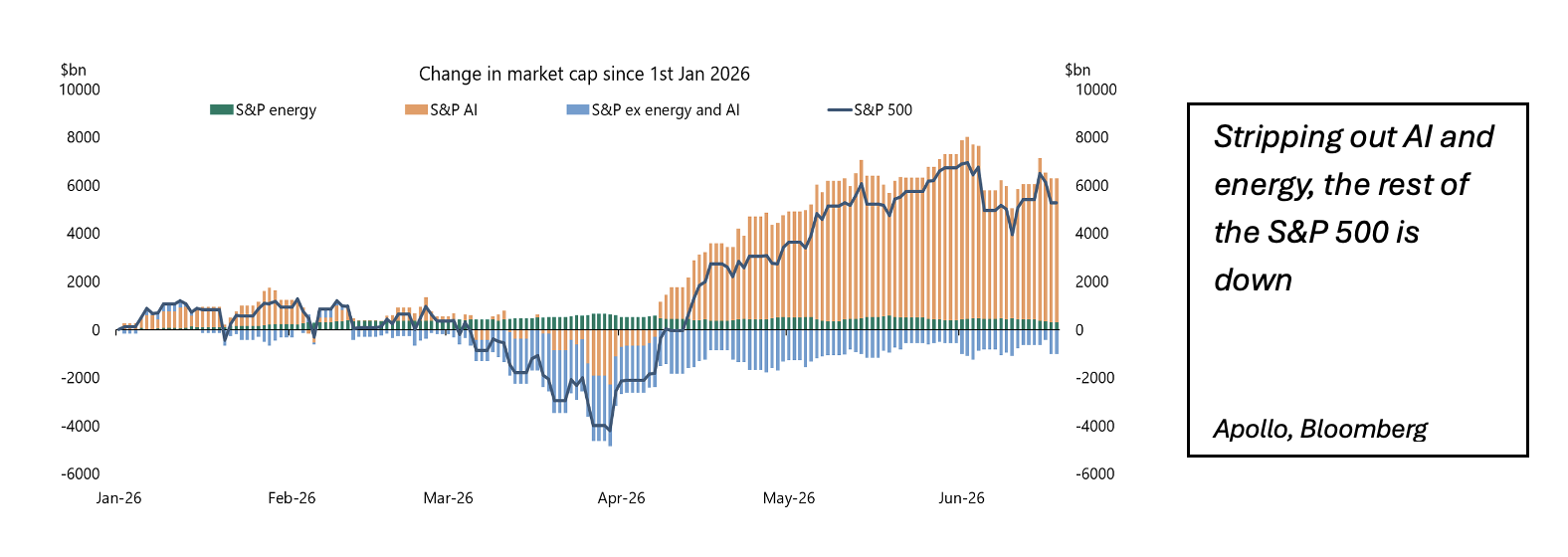
- Equity markets more than recovered March declines
- US equities (S&P 500), +9.2%
- Driven by semiconductors, +90%, IT hardware +24%, energy, +19%
- Broad indifference to other market sectors
- AI demand and supply growing ahead of expectations
- Historic price gains in chips, materials & equipment stocks
- Industries and companies that support data center building also fared well
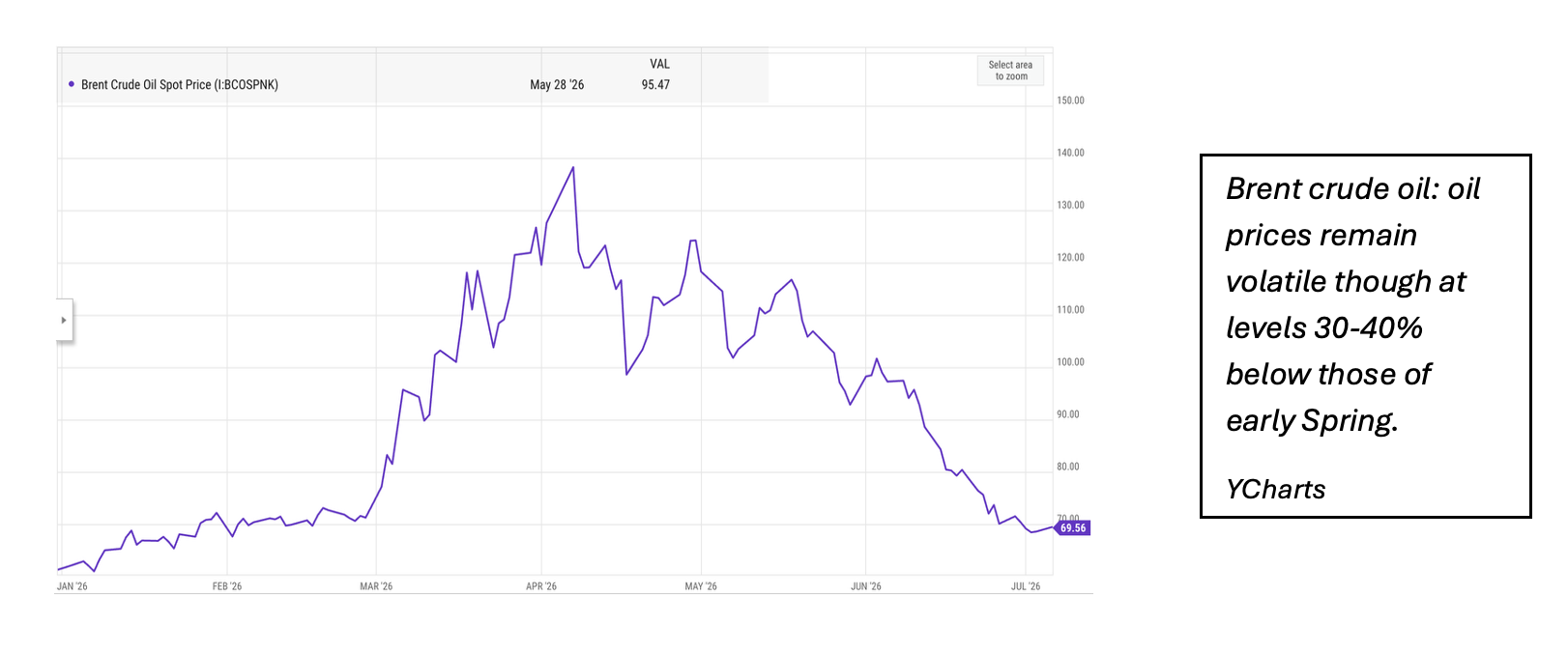
- The March surge in oil & derivative products reversed by June
- Markets priced eventual re-opening of the strait of Hormuz
- Inflation expectations lifted by US growth as well as energy prices
Changing Perspectives
Market momentum in the 1st half of 2026 was dominated by AI suppliers and energy companies. Most sectors in the US equity market declined in the 1st half of the year. The context, however, continues to evolve – as does the cast of winners and losers. We do not expect AI spending to suddenly lose momentum; nor do we expect a clean resolution to the tensions in the Middle East. Yet both the AI and global energy landscapes are rapidly shifting. The tentative reopening of the Strait since mid-June not only reduced oil and related input prices, it also boosted prices of stocks outside of the crowded AI, power and energy themes. In coming quarters, we expect consensus perspectives to be challenged by a fading energy supply shock and by fewer outsized growth surprises from AI data center suppliers.
We remain constructive on equity markets precisely because of the broad range of high-quality businesses compounding profit at attractive rates while their stocks trade at reasonable, even cheap, valuations. Importantly, this observation pertains even to the companies at the very core of the AI buildout. Concerns about returns on heavy current investment leave them trading at surprisingly reasonable valuation multiples.
The imperative for the US to dominate AI – both in competition with China and for global security reasons – encourages a search for affordable, abundant energy. This quest for resources encompasses OPEC+ countries such as Venezuela and Iran. Possibly, this AI energy imperative has contributed to geopolitical frictions given the likely proliferation of AI globally, both in civilian and military spheres.
Perspective on AI & data-center demand
The soaring growth displayed by data center suppliers, particularly chip makers, paused only briefly during the outbreak of war in March. AI-related businesses lead the US and global equity markets and account for the bulk of positive revisions to earnings forecasts. Historically, the capital-intensive and highly-cyclical semiconductor industry has tended to provide trading opportunities rather than long-term investment gains. One could have called time on this rally back in 2024 or in late 2025 (Microsoft, one of the largest providers of computing power, pulled back on its spending plans in early 2025 – before quickly reversing course). The current surge in chip-maker share prices is now in its 3rd year; yet the major players continue to post impressive growth in profits. While demand from US data center operators surges, there is little spare chip capacity available before 2028—and even that additional capacity may not be sufficient to meet demand levels in two years’ time. Unsurprisingly, prices for all chips and related components, even the most basic, have surged in recent months.
Our own views on the semiconductor “supercycle” continue to evolve. In recent months, attention has shifted from graphic processing units (GPUs), vital to the creation of large-language models (LLMs), including ChatGPT, Gemini and Claude, to the growing role of central processing units (CPUs) in supporting AI inference tasks. Optical networking and AI-enabled devices have also emerged as high-growth segments. This new phase of AI demand will likely favor a different set of suppliers. Despite the frenzied rise in prices of certain stocks, we should view AI as a long game.
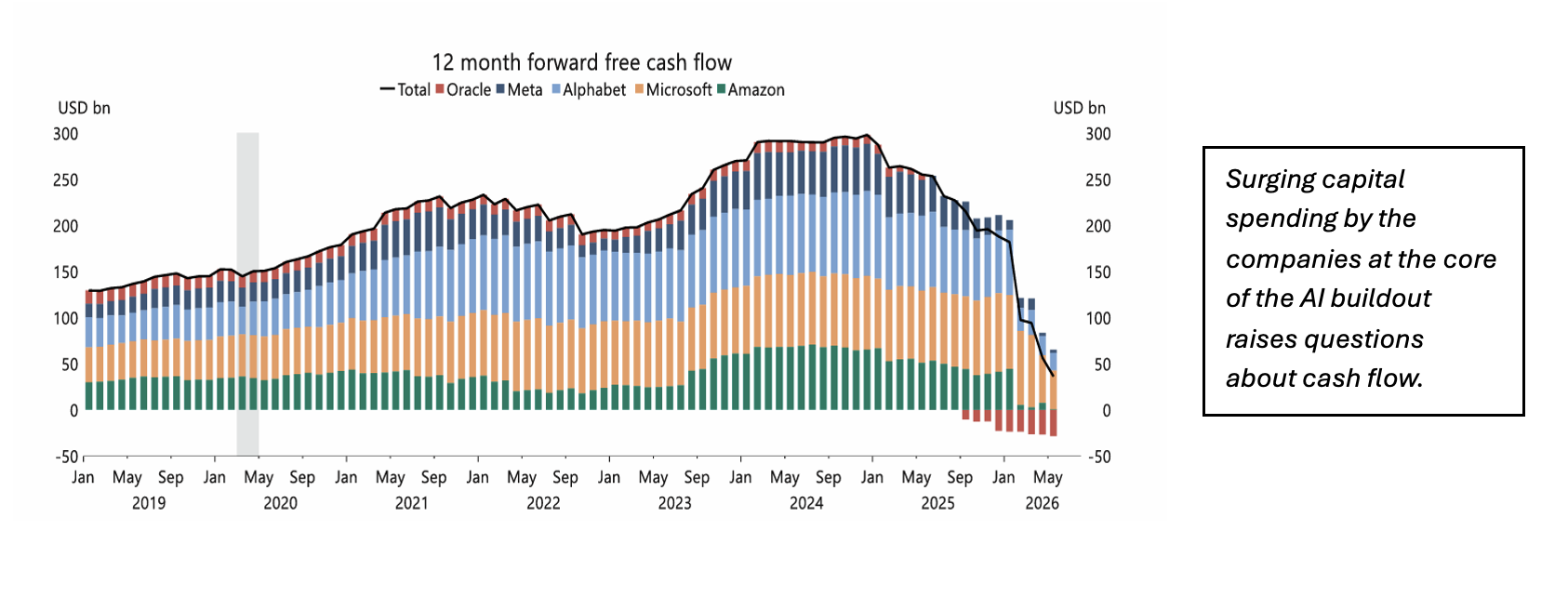
The “hyperscalers,” i.e., the largest data center operators, remain dominant in the competitive landscape and in the stock market. Each of them is valued at well over $1 trillion. Yet the financial profiles of these gigantic companies appear very different today compared to only 2 years ago.
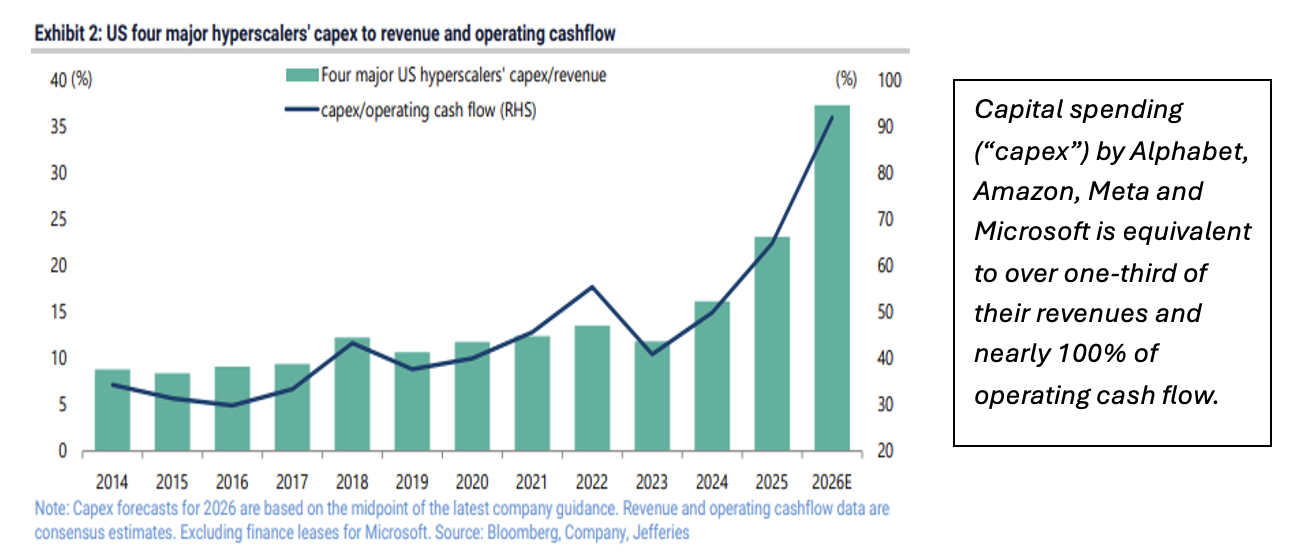
We profile META in the following section of this memo as an example.
Many leading businesses outside the AI theme trade 20-40% below their prices of 12 months ago, even though their earnings are substantially higher. Such large discounts reflect three distinct pressures:
- an anticipated demand shortfall as worried consumers react defensively to inflation
- the stunning growth rates recorded by AI suppliers, which overshadow more normal growth rates elsewhere
- Related worries about competition from new AI-based systems along with their negative impact on employment and consumer demand
The discounts on the “non-AI” sectors appear misplaced, for the following reasons:
- First, the strength of recent corporate earnings and outlooks remains broad based.
- Earnings growth combines with better-than-expected consumption metrics in the US and many countries.
- Travel spending, for instance, failed to deteriorate despite the war and higher fuel costs.
- Second, companies buying AI-based tools expect productivity gains from them
- nor is it clear that labor will be decimated as these new tools require their own forms of human interaction and supervision.
- Third, although lacking the extraordinary growth momentum associated with the AI infrastructure buildout, a wide array of stocks in the consumer, healthcare and other sectors benefit from low expectations.
- We caution that the same is not true for the AI “pick-and-shovels” stocks.
Further support for equities could result from an easier commodity price backdrop in the 2nd half of 2026. The status of the Strait of Hormuz, one of the world’s major energy chokepoints, is key to near-term market pricing of stock as well as bond prices. Despite ongoing hostilities with no clear end in sight, we expect easing oil price pressures. The longer the conflict endures, the more urgent the development of new resources and new routes to market becomes. In coming years, we expect that new supply channels will be opened in competition with the Strait, while new energy supplies, of both fossil and non-fossil-fuel resources, will come online. Importantly, for equity and bond investors, as well as for consumers, easing commodity prices would support easing of borrowing costs in the future.
Portfolio Decisions
Meta Platforms (META)
We have owned META shares for several years, and during this holding period investor perceptions have changed dramatically. Recent concerns center on whether the company’s large capital investments – primarily on datacenters to support META’s bold artificial intelligence initiatives - will generate acceptable financial returns. These concerns are valid: META has gone from generating tens of billions of dollars in annual free cash flow to break-even in 2026. As of June 30th, META traded 30% below its peak and at the same range as it did during the summer of 2024.
Despite the current pessimism surrounding the name, there are reasons to be constructive. First, investments to improve content recommendation, expand creator tools, and improve advertiser returns have benefited META’s core advertising business. Revenue growth accelerated to >30% y/y in Q1 of this year. And earnings growth remains positive, though at a slower rate. A portion of META’s investments is clearly generating tangible benefits to the core business.
Additionally, management has started to take the market’s concerns more seriously. Press releases from META in recent months have acknowledged concerns on capital expenditure levels and detailed new revenue opportunities that the company’s spending could allow them to pursue. These include offering cloud computing services to other businesses, selling access to their internally developed LLM (Muse) to businesses and consumers, and enhancing the monetization of their core apps (Facebook, Instagram, WhatsApp) with the introduction of AI “business agents” that can automate communications, enhance customer support, and facilitate sales.
Each of these are large market opportunities that can move the needle, even for a company of META’s size. Importantly, if META is successful in scaling some of these new revenue streams the rationale for their substantial capital expenditures could become clear to investors. In that scenario we would expect shares to rerate higher from current valuation levels.
We are grateful for the confidence you have placed in our abilities. We welcome your observations and questions, as always.
Sincerely,
Bridgehampton Group
For questions or follow-up, please reach out to any member of our team. https://www.ingalls.net/bridgehamptongroup/about-us
Ingalls & Snyder, LLC, is an investment advisor registered with the U.S. Securities & Exchange Commission and a FINRA member broker dealer. This material is being provided to you for informational purposes only and is not intended to be a general guide to investing, or as a source of any specific investment recommendation and makes no implied or express recommendation concerning the manner in which any account should be handled. Any investment program involves certain risks, including loss of principal, and no assurance can be given that any specific investment objective will be achieved.

Ingalls & Snyder is a brand name used for the affiliated companies of I&S Group, LLC. Bridgehampton Group is a team at Ingalls & Snyder that offers investment advisory and brokerage services. Investment advisory services are offered through Ingalls Investment Management, LLC ("IIM"), an SEC registered investment adviser, and brokerage services are offered through Ingalls & Snyder, LLC ("INGS"), a member of FINRA and SIPC. When offering investment advisory services, individuals act as investment advisor representatives or, otherwise, employees of IIM. When offering brokerage services, individuals act as a registered representatives or associated persons of INGS.
For more information and disclosures regarding Ingalls & Snyder, LLC and Ingalls Investment Management, LLC, please visit the Important Information page. In addition, you may check Ingalls’ regulatory history and background on FINRA’s BrokerCheck website.